This fall the big AI companies all shipped always-on agents. OpenAI has Dots, Meta has Muse, xAI has Grok Bot, and Anthropic just added Claude Duet. Each one runs on a computer in its company's cloud, keeps working after you close the app, and gets more useful the more it knows about you.
For one of these agents to know you, what it knows has to live in its cloud: your preferences, your projects, the context you gave it last week. Each one builds its own copy of you, and that copy belongs to the platform. If you try a second agent you start over with it, and if you leave, the copy stays with them.
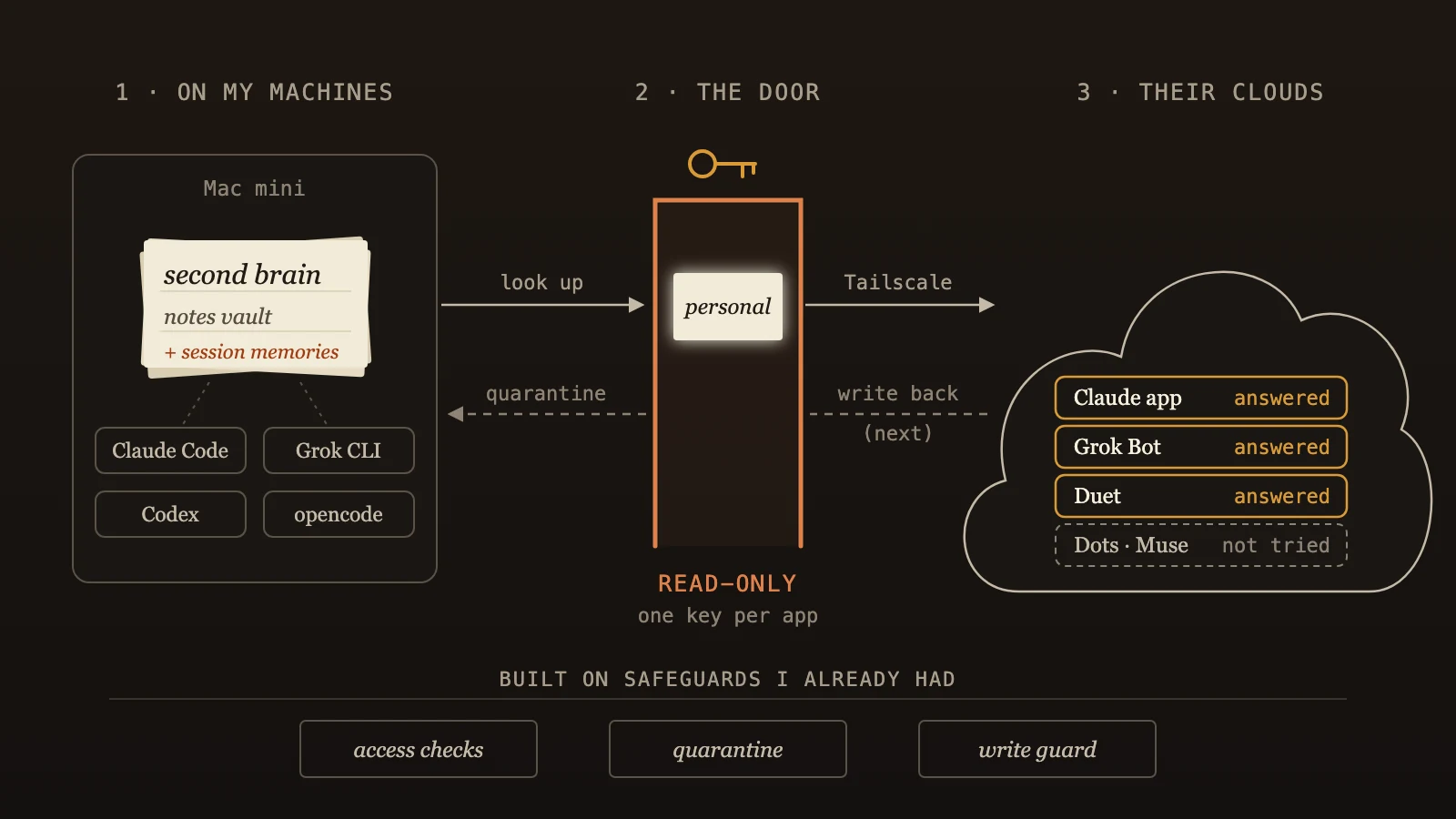
I have been building the other way for a while. My second brain is a notes vault on my own machines, where my plans, projects, people and decisions live. Next to it is memory: the lessons and preferences my agents have saved from my previous sessions, on every machine. Claude Code, the Grok CLI, Codex and opencode on my machines all share the memory and the vault, and anything new they want to remember waits until I approve it. None of it lived in anyone's cloud, which also meant none of my cloud agents could use it.
Today I asked my ranch agent how to get it to Duet and to Grok Bot. The memory server already spoke MCP, so the agent put a small web front end on it on the Mac mini, behind a Tailscale Funnel, and I added it as a custom connector in claude.ai and in Grok Bot. The same afternoon Claude, Duet and Grok Bot were all answering questions from what my agents had already learned instead of asking me.
So now my cloud agents borrow my context instead of keeping their own copy of it. The source stays on my machines. Each app has its own key, so I can cut one off without touching the others, and an agent I try next month gets the same second brain on day one. (Dots and Muse should work the same way if they take custom connectors; I haven't tried them yet.)
There are rules, because this is the first time any of it has a door on the internet. It is read-only for now. It also takes advantage of the security features my memory system already had: the same checks that decide what each of my local agents is allowed to see now decide what the cloud agents see, so it was safe to open up. Whatever an agent reads ends up in that conversation on their side, so I am careful about what goes out at all.
Syncing the other way is next. Right now my cloud agents can read but not write. When they can, anything they learn will come home the way it does for my local agents: it waits in quarantine until I approve it, and then every agent has it, in the cloud or on my desk.
The agents will keep coming, and each one would like to hold its own copy of me. I would rather lend them mine. My notes and memories stay on my machines and the agents I use get to read them; if I switch agents next month, everything I've built stays with me.